
Ancient Greece island sites: 8 legendary wonders to see
Explore 8 legendary ancient Greece island sites on Crete, Rhodes, Santorini, and beyond. Discover ruins, myths, and practical tips for your heritage journey.

TL;DR:
- The Greek islands served as central hubs for ancient trade, religion, and culture development.
- Crete’s Knossos and Santorini’s Akrotiri offer unique insights into Minoan civilization, with contrasting preservation methods.
- Rhodes and other islands boast layers of history, from the Colossus of Rhodes to medieval fortresses and archaeological sites.
Most travelers picture the Acropolis when they think of ancient Greece. Yet some of the world’s most transformative archaeological discoveries were made not on the mainland, but on sun-drenched islands. Crete gave us the labyrinthine palace of Knossos and the myth of the Minotaur. Rhodes raised a bronze giant 33 meters into the sky. Santorini’s Akrotiri buried an entire Bronze Age city beneath volcanic ash, preserving it almost perfectly for 3,500 years. From Samos to Karpathos, Mykonos to Paros, the Greek islands hold layer upon layer of myth, ruin, and revelation. This guide invites you to explore them with the depth they deserve.
Table of Contents
- Why the Greek islands matter: Foundations of ancient wonders
- Crete: Knossos, Minoan legacy, and Akrotiri’s untouched story
- Rhodes: From the Colossus to layers of legendary history
- Practical tips for visiting Greece’s ancient wonders
- The surprising lessons Greek islands teach us about ancient innovation
- Ready to explore? Plan your Greek island adventure
- Frequently asked questions
Key Takeaways
| Point | Details |
|---|---|
| Cultural significance | Greek islands like Crete and Rhodes are ancient cultural hubs with global influence. |
| UNESCO heritage | Many island sites enjoy UNESCO protection, ensuring their preservation and accessibility. |
| Contrasting sites | Sites differ: some are authentically preserved like Akrotiri, others are reconstructed like Knossos. |
| Practical planning | Plan visits thoughtfully for the best experiences—use expert guides and respect site rules. |
Why the Greek islands matter: Foundations of ancient wonders
The Greek islands were not peripheral to ancient civilization. They were its nerve centers. Trade routes, religious pilgrimages, and diplomatic missions all converged on islands like Crete, Rhodes, Samos, and Delos. The Minoans, who flourished on Crete from roughly 2700 to 1450 BC, developed one of Europe’s first writing systems and built palatial complexes that rivaled anything on the mainland. The Aegean islands nurtured the oracle traditions, the birth myths of Apollo (tied to Delos), and the seafaring cultures that gave Western art and architecture its foundational vocabulary.
These islands were not simply beautiful backdrops. They were active agents in shaping Mediterranean history. Samos produced the philosopher Pythagoras and the engineer Eupalinos, whose tunnel is one of antiquity’s greatest feats. Paros supplied the luminous white marble that sculptors across the ancient world prized above all others. Mykonos served as a gateway to sacred Delos. Karpathos preserves some of the most archaic Greek dialects still spoken today, a living thread to antiquity.
Greece’s UNESCO heritage islands reflect this breadth of significance, and Greece hosts 20 UNESCO sites including major islands and their heritage, a number that grew in 2025 with the inscription of the Minoan Centers.
Key UNESCO and heritage sites found on Greek islands include:
- Old Town of Rhodes (UNESCO World Heritage Site)
- Minoan Centers of Crete (UNESCO inscribed in 2025)
- Delos (sacred island and archaeological zone)
- Pythagoreion and Heraion of Samos (UNESCO World Heritage Site)
- Akrotiri on Santorini (exceptional Bronze Age preservation)
Pro Tip: Visit these sites in April, May, or October. Shoulder seasons offer cooler temperatures, far fewer crowds, and a more contemplative pace that genuinely transforms the experience of standing among ancient stones.
For anyone planning Greek island trips, understanding this broader historical web makes each individual site more meaningful, not just a collection of ruins but a connected story.
Crete: Knossos, Minoan legacy, and Akrotiri’s untouched story
Understanding the Minoan world begins on Crete, where myth and reality overlap in ways that still provoke debate among archaeologists. Knossos is the island’s crown jewel, a sprawling palace complex covering roughly 20,000 square meters, once home to Crete’s most powerful rulers. Its labyrinthine corridors inspired the legend of the Minotaur, and its frescoes depicting bull-leaping athletes and blue monkeys remain among antiquity’s most vivid images.
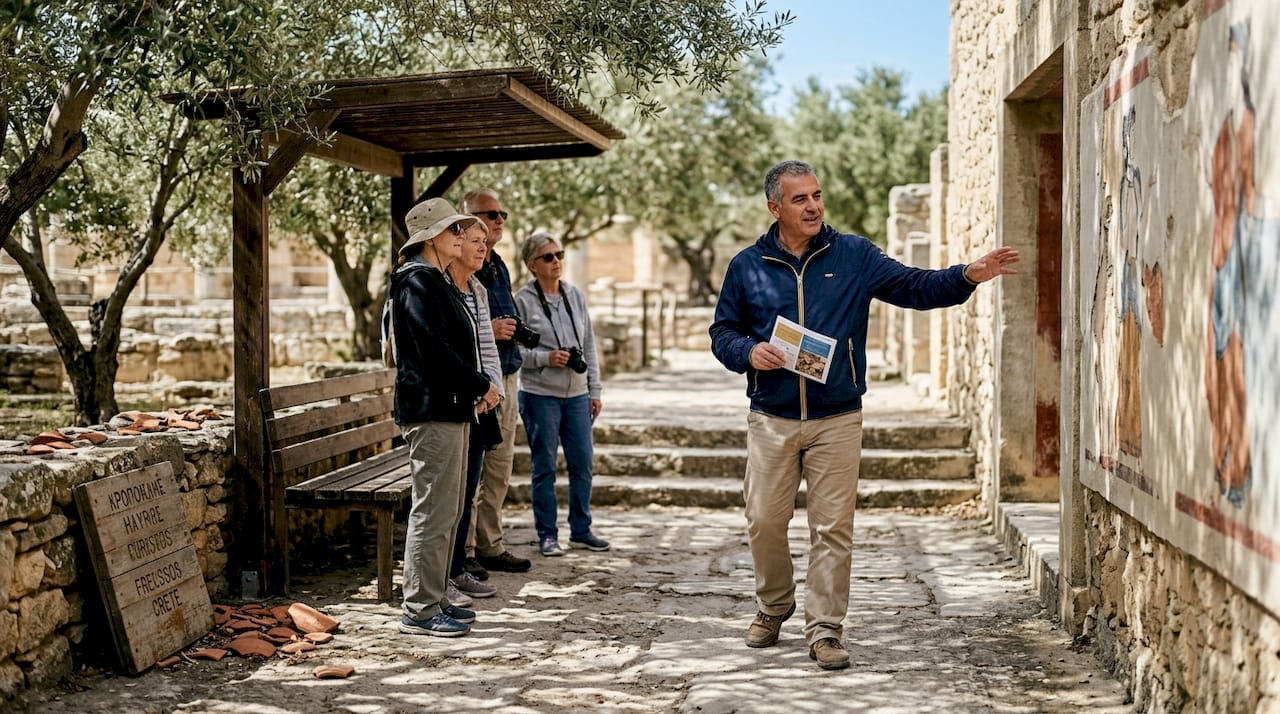
Yet Knossos is also controversial. British archaeologist Sir Arthur Evans, who excavated the site starting in 1900, went far beyond documenting what he found. Evans’ reconstruction used controversial concrete methods and recreated frescoes based largely on assumption, meaning significant portions of what visitors see today reflect early 20th-century imagination as much as Minoan reality. Scholars continue to debate how much Evans’ vision obscures the original.
Akrotiri on Santorini offers a striking counterpoint. When the Thera volcano erupted around 1627 BC, it buried this Minoan-influenced town in ash, preserving streets, multi-story buildings, and extraordinary frescoes almost intact. No human remains were found, suggesting the population evacuated before the disaster. The Minoan Centers recognized as UNESCO World Heritage sites in 2025 include both the Knossos palace complex and associated Minoan sites across Crete.
| Feature | Knossos | Akrotiri |
|---|---|---|
| Period | 2000–1375 BC | circa 1627 BC (abandoned) |
| Reconstruction | Extensive, using concrete and repainted frescoes | None; preserved under volcanic ash |
| Key discoveries | Throne Room, Linear B tablets, bull fresco | Multi-story homes, intact pottery, vivid frescoes |
| Visitor experience | Visually dramatic, partially recreated | Raw, atmospheric, deeply original |
| Entry notes | Open year-round; audio guides available | Covered excavation; roof protects the site |
“Akrotiri’s preservation is so complete that it invites genuine empirical study. Every wall, every pot, every painted fish on a fresco is where the Minoans left it. That is an irreplaceable gift to human knowledge.”
Pro Tip: At both Knossos and Akrotiri, hire a licensed guide who specializes in Aegean prehistory. The context they provide turns a walk through ruins into a genuinely moving encounter with the ancient world, especially at wellness heritage experiences designed around slower, more intentional travel.
Rhodes: From the Colossus to layers of legendary history
Leaving Crete’s Bronze Age behind, the narrative of wonder and transformation continues on Rhodes. This island’s history reads like a sequence of civilizations, each leaving a distinct imprint on the landscape. The most famous was a statue: the Colossus of Rhodes, one of the Seven Wonders of the Ancient World. Built between 292 and 280 BC, it stood approximately 33 meters tall and was erected to celebrate Rhodes’ victory over a Macedonian siege. It stood for only 54 years before an earthquake brought it down, yet its legend shaped the imagination of the Western world for centuries.
| Era | Event | Legacy |
|---|---|---|
| 292 BC | Construction begins | Monument to Rhodian independence |
| 280 BC | Completed | One of Seven Wonders of the ancient world |
| 226 BC | Earthquake destroys it | Ruins remained visible for centuries |
| 654 AD | Arab conquest melts remnants | Only the legend survives |
The Lindos Acropolis features Greek temples dating to 1100 BC and is part of a UNESCO site, layered with Byzantine chapels and a Crusader castle that together tell 3,000 years of history on a single clifftop. Standing there, looking out across the deep blue Aegean, you feel time folding into itself.
Must-see historical sites on Rhodes for history lovers:
- Lindos Acropolis: Temple of Athena Lindia, Crusader fortifications, Byzantine church
- Ancient city of Kameiros: A Doric city abandoned after an earthquake, wonderfully preserved
- Valley of the Butterflies: A natural site with documented ancient religious significance
- Archaeological Museum of Rhodes: Houses Hellenistic sculpture and Mycenaean artifacts
- Medieval Old Town: A UNESCO World Heritage Site with intact city walls and Knights’ Street
For Rhodes’ luxury heritage options or simply reasons to visit Rhodes, the island rewards visitors who take time to move beyond the beaches and into its layered historical core.
Practical tips for visiting Greece’s ancient wonders
After discovering the wonders themselves, planning a visit is the next adventure. Greece’s ancient sites are remarkable, and they require thoughtful preparation to experience fully and respectfully.
Steps for preparing an island-hopping ancient wonders tour:
- Research site-specific opening hours well in advance. Many sites adjust schedules seasonally, and some (like Akrotiri) close for periodic restoration.
- Book tickets online for major sites such as Knossos and Lindos Acropolis, especially between June and September, when queues can be long.
- Plan your island sequence logically: Crete as a base for Minoan history, then Rhodes for multi-era history, Santorini for Akrotiri, Samos for the Pythagoreion.
- Pack appropriately: Comfortable walking shoes, sun protection, and a refillable water bottle. Many sites have uneven terrain and minimal shade.
- Engage local guides certified by the Greek Ministry of Culture. Their knowledge transforms what might otherwise be a walk among labeled stones into a living narrative.
Dos and don’ts at archaeological sites:
- Do stay on designated paths. Soil compaction damages buried archaeological layers that excavators have not yet reached.
- Do not touch frescoes, inscriptions, or carved surfaces. Skin oils degrade ancient pigments rapidly.
- Do visit the associated museums. Artifacts removed for preservation are often displayed nearby, and they add essential context.
- Do not arrive without water or rest time. These are outdoor sites in a Mediterranean climate.
Pro Tip: Use the official UNESCO World Heritage website and the Greek Ministry of Culture’s portal for the most current restoration updates before traveling. Some sections of major sites open and close as work progresses.
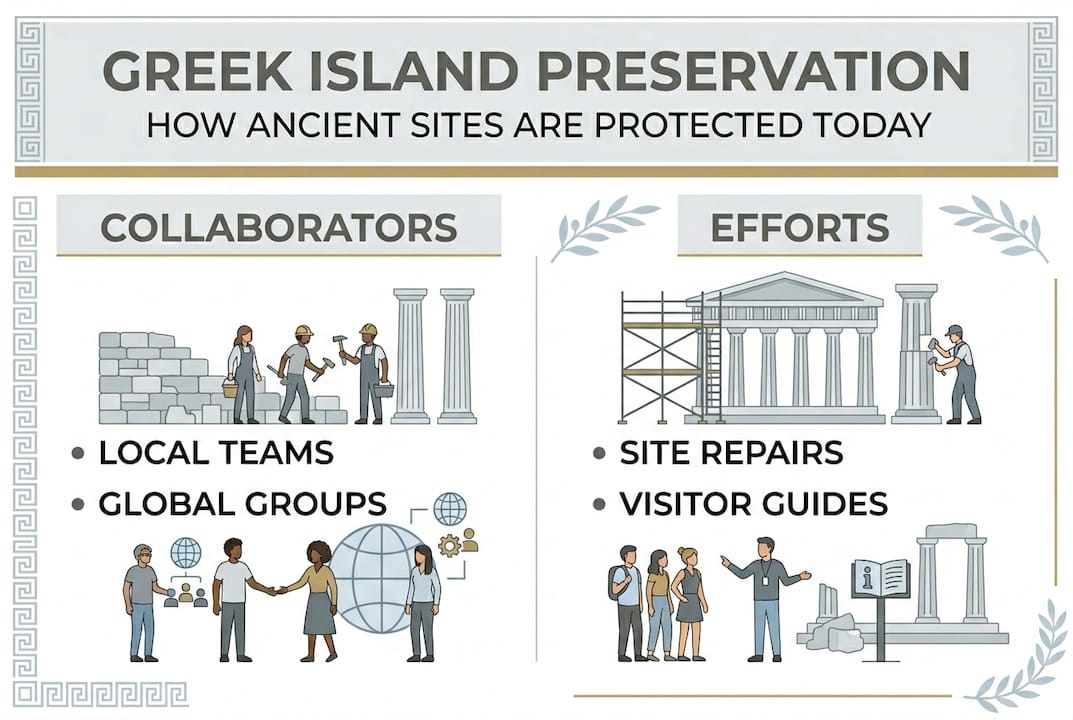
Preservation at Greece’s ancient sites depends on collaborative preservation efforts between Greek archaeological ephorates (the regional bodies that oversee sites) and international partners including the European Union and various university research programs. When you follow site rules, you actively support that ongoing work. For deeper planning your ancient site trips, consider building flexibility into your itinerary so that a site closure or restoration zone becomes an opportunity to explore a nearby museum rather than a frustration.
The surprising lessons Greek islands teach us about ancient innovation
But beyond logistics, what do these ancient sites truly teach us today? Conventional wisdom tends to treat ruins as static monuments, objects to be preserved exactly as found. The Greek islands challenge that view in a quietly profound way.
Knossos and Akrotiri sit at opposite ends of the interpretation spectrum. Akrotiri, untouched and roofed for protection, invites empirical study precisely because nothing was added. Knossos was rebuilt with imagination and ambition, which made it accessible and dramatic, yet also controversial. Both approaches teach us something real: that archaeological sites are never simply neutral. Every decision about what to restore, what to leave, and what to display is itself a cultural act.
The broader island story reinforces this. Rhodes was conquered and reconquered. Samos produced both Pythagoras and tyrants. Kefalonia’s ancient sites sit alongside earthquake-rebuilt villages. Karpathos holds archaic dialects alongside modern life. These are not museums. They are living places where history is still being written. The most honest way to plan meaningful heritage trips is to arrive not with certainty but with curiosity, ready to let both myth and critical inquiry inform what you see.
Ready to explore? Plan your Greek island adventure
Greece’s island wonders are best experienced with insightful planning and the right support. The sites we have explored, from Knossos’s painted corridors to the clifftop temples of Lindos, reward travelers who arrive informed and unhurried.
At Longevity Travel, we have spent over three decades curating journeys across Greece’s most significant landscapes. Our heritage travel programs are designed for travelers who want more than a checklist. They are for people who want to stand in a Bronze Age city and genuinely feel where they are. Visit Longevity Travel to begin designing a Greek island journey shaped around depth, discovery, and lasting memory.
Frequently asked questions
What is the most impressive ancient site on the Greek islands?
Knossos on Crete is widely considered the most impressive for its sheer scale and mythic resonance. That said, Evans’ reconstruction used concrete and recreated frescoes, so visitors should engage with it critically alongside its museum.
Can you visit the site of the Colossus of Rhodes today?
The Colossus no longer stands, but you can explore the harbor where it is believed to have stood, along with Medieval Rhodes as a UNESCO site and the Lindos Acropolis nearby.
Which Greek island sites are UNESCO World Heritage sites?
Notable UNESCO designations include the Old Town of Rhodes, the Pythagoreion and Heraion of Samos, and the Minoan Centers of Crete. Greece hosts 20 UNESCO sites in total, spanning both islands and the mainland.
Is it better to visit reconstructed or untouched ancient sites?
Both offer value, but in different ways. Knossos’ reconstruction versus Akrotiri’s preservation illustrates the trade-off clearly: reconstructions are visually immersive, while untouched sites offer more reliable evidence and a rawer sense of discovery.
Recommended
Planning a family holiday in Greece? We'll help you pick the right island and hotel.
Explore Greek destinationsNewsletter
A memory for life
Weekly to your inbox: inspiration, longevity insights and exclusive travel offers.