
Best photography spots in Greece: iconic views and hidden gems
Discover the best photography spots in Greece, from Santorini's blue domes to Karpathos cliffs. Expert tips on timing, gear, and hidden gems for stunning Instagram shots.

TL;DR:
- Greece offers diverse, contrast-rich locations ideal for breathtaking photography.
- Optimal photos are achieved through timing, composition, lighting, and capturing authentic moments.
- Less crowded, off-the-beaten-path spots provide unique, compelling images beyond popular landmarks.
Greece is one of those rare places where nearly every corner looks like a painting waiting to be captured. With Greece ranking 7th globally among the most photographed destinations in the world, the real challenge is not finding beauty, but knowing where to point your lens first. From Santorini’s electric blue domes and Rhodes’s medieval stone lanes to the rugged cliffs of Karpathos and the lush greenery of Kefalonia, this guide curates the very best photography spots across the Greek islands. We will walk you through what makes each location special, when to visit, and how to capture it at its most breathtaking.
Table of Contents
- What makes a photography spot stand out in Greece?
- Santorini caldera: Blue domes and volcanic magic
- Athens: The Parthenon and Acropolis
- Mykonos: Panagia Paraportiani and Cycladic charm
- Off-the-beaten-path and bonus spots
- Our perspective: Why storytelling matters more than the perfect shot
- Plan your ultimate photo journey in Greece with Longevity Travel
- Frequently asked questions
Key Takeaways
| Point | Details |
|---|---|
| Top photo criteria | The best spots combine iconic views, unique architecture, and fantastic light for breathtaking shots. |
| Essential gear guide | Bring a wide-angle, mid-zoom, and telephoto lens plus a tripod to maximize your capture options in Greece. |
| Santorini and Mykonos tips | Plan photo sessions early or late in the day for the best color and least crowds at these famous islands. |
| Go beyond the icons | Hidden gems like the Temple of Poseidon and lesser-known beaches offer stunning visuals without the crowds. |
| Make photos personal | Focus on storytelling and unique angles to create memorable images that stand out on social media. |
What makes a photography spot stand out in Greece?
Not every beautiful place is a great photography spot. The two things are related, but they are not the same. A truly outstanding location for your camera needs several elements working together at once.
Here is what we look for when evaluating a Greek photography location:
- Visual contrast: White-washed walls against a cobalt sea, vivid bougainvillea draped over blue doors, volcanic rock meeting gentle surf. Greece delivers contrast in abundance.
- Architectural character: Ancient temples, Cycladic cubes, Byzantine domes, and Venetian harbor fronts each tell a distinct visual story.
- Lighting windows: The Mediterranean sun is brilliant but harsh at midday. Spots that reward golden hour and blue hour visits consistently produce the most memorable shots.
- Accessibility and crowd management: Some iconic spots are best visited at dawn or in the off-season to avoid the masses. Others are naturally secluded.
- Gear compatibility: Wide-angle lenses for sweeping vistas, mid-zoom for architecture, telephoto for isolating colorful details like a single red geranium against a white wall.
For broader vacation tips for Greece that help you plan around the best photo opportunities, local knowledge makes all the difference. Islands like Paros, Samos, and Mykonos each have their own visual personality, and knowing what to expect shapes how you pack and plan.
Pro Tip: Bring a circular polarizing filter for Greece. It cuts glare off the sea and makes blue skies richer without editing. Pair it with your wide-angle and you will capture colors that feel almost unreal.
Santorini caldera: Blue domes and volcanic magic
Having outlined our criteria, let’s jump into the iconic locations, starting with perhaps the most recognizable of all.
Santorini is the image most people picture when they think of Greece. But beyond the postcard clichés, it is genuinely one of the most photogenic places on the planet. The caldera, carved by an ancient volcanic eruption, creates a dramatic bowl of deep blue water ringed by white cliff villages. Oia and Fira are your two anchor points.
Key shots to chase in Santorini:
- Blue domes of Oia: Shoot from the narrow path above the domes with a wide-angle lens to frame them against the sea and sky.
- Caldera-edge lanes: Winding alleys with bright pink bougainvillea, blue doors, and whitewashed steps reward a mid-zoom for compressed, layered compositions.
- Sunset from Oia’s castle: Arrive at least 90 minutes early to claim your spot. The golden hour light over the caldera turns every surface to amber and rose.
- Blue hour: Stay 20 minutes after sunset. The fading sky and softly lit village create a cinematic calm that golden hour crowds miss entirely.
“A wide-angle lens is essential for caldera shots; a tripod and ND filter are strongly recommended for long exposures and controlled light.” Pixeo
For a deeper understanding of what makes Santorini’s light and landscape so unique, the island’s holistic sensory environment is rooted in its volcanic geography, and that geology shapes everything from the color of the rock to the quality of the evening glow.
Pro Tip: Visit Oia’s back alleys before 8 a.m. You will find the same blue doors and bougainvillea without a single other photographer in the frame.
Athens: The Parthenon and Acropolis
From the islands to the capital, Athens offers ancient grandeur and urban photography appeal.
The Parthenon is the most photographed spot in Greece, generating over 25 million social media photos annually. That number is staggering, and it reflects something real. Standing on the Acropolis as dawn light rakes across the marble columns is one of the most emotionally powerful photography experiences you can have in Europe.
How to photograph the Acropolis at its best:
- Arrive at opening time: The Acropolis opens at 8 a.m. The first 30 minutes offer clean sight lines, soft directional light, and a fraction of the midday crowd.
- Shoot from Filopappou Hill: This opposite hilltop gives you a full frontal view of the Parthenon with the city spread below. Ideal for wide-angle compositions at sunrise.
- Look for the details: Carved metopes, worn column fluting, and scattered marble fragments all reward a telephoto lens and a patient eye.
- Evening city views: The illuminated Acropolis at dusk, shot from the Monastiraki neighborhood below, is a compelling urban night-photography subject.
If you love combining adventure with your photography, outdoor adventures in Greece across islands like Crete and Rhodes will keep your portfolio as diverse as your itinerary.
Mykonos: Panagia Paraportiani and Cycladic charm
Just a short ferry ride away, Mykonos brings a different, vibrant flavor to your lens.
Panagia Paraportiani is the most photographed church in Greece. It is actually five small chapels fused together over centuries into one asymmetric, organic form. Built directly beside the sea in Mykonos Town, it glows an almost luminous white under direct sun and turns amber gold at sunset.
Shooting Panagia Paraportiani well:
- Composition: Get low and shoot upward to emphasize the irregular, sculptural shape against the sky.
- Light timing: Late afternoon gives warm tones; blue hour creates a dramatic contrast between the white walls and the darkening harbor sky.
- Wide vs. detail: Use a 24mm wide-angle for the full architectural sweep, then switch to a 50mm or 85mm to isolate surface textures and the faded blue doors at its base.
Beyond the church, Mykonos’s cosmopolitan energy spills into every corner of its old town. Shoot the colorful geometry of shuttered windows, bright flower boxes, and narrow lanes where cats nap in afternoon shade. The island’s visual energy is restless and joyful. Paros, just 40 minutes away by ferry, offers a quieter Cycladic alternative with the same white-and-blue palette but far less competition for your shot.
Pro Tip: In Mykonos Town, look for the small blue door details and terracotta pots in the lanes behind Little Venice. These overlooked corners are far more personal than the main waterfront.
Off-the-beaten-path and bonus spots
While the classics draw the crowds, Greece’s coastlines and ruins hide treasures for the intrepid photographer.
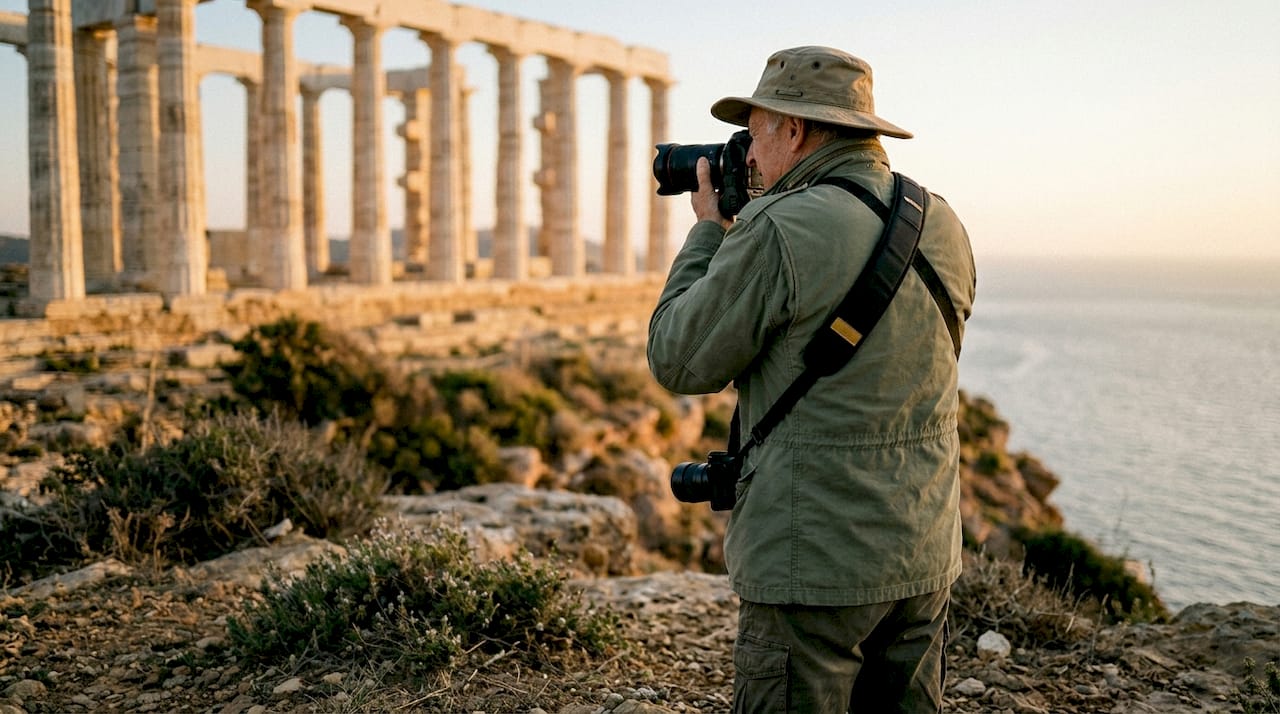
The Temple of Poseidon at Cape Sounion offers dramatic Doric ruins perched on a cliff above the Aegean, with sunset views that rank among the most spectacular in the country. Arrive an hour before sunset and position yourself to the southwest to frame the columns against the fading sky and sea.
More spots worth your memory card:
- Karpathos: Rugged cliffs, deep-blue coves, and traditional villages with vivid red and blue painted details that look stunning in mid-afternoon light.
- Kefalonia: The emerald waters of Myrtos Beach set against white limestone cliffs create one of Greece’s most dramatic natural compositions.
- Samos: Dense forest meeting the Aegean, plus the ancient Heraion sanctuary for architectural contrast against green hills.
- Rhodes Old Town: Cobblestone lanes, hidden gems in Rhodes and Crete, and honey-colored medieval stone walls that warm beautifully in late afternoon sun.
- Crete, Balos Lagoon: A shallow turquoise lagoon with white sand and a rugged peninsula backdrop that photographs like a tropical dream within a Mediterranean reality.
| Location | Visual highlights | Best lens | Best time |
|---|---|---|---|
| Temple of Poseidon | Doric ruins, cliff edge | Wide-angle, telephoto | Sunset |
| Karpathos | Cliffs, color details | Mid-zoom | Afternoon |
| Kefalonia, Myrtos | Limestone, emerald water | Wide-angle | Midday |
| Samos | Forest, sanctuary ruins | Wide-angle, mid-zoom | Morning |
| Rhodes Old Town | Medieval stone, lanes | Mid-zoom, 35mm | Late afternoon |
| Crete, Balos | Lagoon, sand, peninsula | Wide-angle | Morning |
Our perspective: Why storytelling matters more than the perfect shot
With all of these locations mapped out, one mindset will elevate your feed even further.
Here is what decades of guiding photographers through Greece has taught us: the images that stop people mid-scroll are rarely the technically perfect ones. They are the ones that carry feeling. A pair of worn sandals beside a blue door in Paros. A grandmother hanging laundry in Samos with the sea glinting behind her. A single candle lit inside Panagia Paraportiani during a quiet morning prayer.
Anyone with a capable camera and a flight to Santorini can photograph the blue domes. Very few take the time to sit, observe, and wait for the moment when a location reveals something true about itself. That patience is what separates a travel snapshot from a story.
We encourage you to use the expert perspectives on Greece travel not just for logistics, but as a reminder to slow down. Greece rewards those who linger. The light shifts, the crowds thin, and suddenly the place becomes yours.
Compose with intention. Let the frame breathe. And ask yourself what feeling you want the viewer to carry away, not just what you want to show them.
Plan your ultimate photo journey in Greece with Longevity Travel
Ready to turn inspiration into a real adventure?
At Longevity Travel, we have spent over three decades building deep, authentic connections across Greece’s most remarkable destinations. We know when the light falls best on the Parthenon, which ferry route gives you a golden-hour arrival into Mykonos, and which Karpathos village lane turns into a natural color gallery every spring afternoon.
If you are ready to design a photography-focused Greece itinerary shaped around your creative vision, our travel consulting for Greece photography trips brings local expertise directly to your planning process. You can also explore curated programs that blend authentic island experiences with the flexibility to chase the light wherever it leads. Your most memorable images are waiting.
Frequently asked questions
What time of year is best for photography in Greece?
Late spring and early autumn offer mild weather, fewer crowds, and softer natural light for stunning photos. The spring and autumn seasons also bring more dramatic skies and richer color saturation than the harsh summer sun.
Which camera gear should I bring to photograph iconic Greek sights?
Pack a wide-angle for landscapes, mid-zoom for architecture, and a telephoto for details, plus a tripod and ND filter for creative shots. A complete lens kit covering these focal lengths will prepare you for every type of Greek scene.
Are there any photography restrictions at major Greek landmarks?
Personal photography is allowed at most sites, but drone use often requires special permits and restriction awareness is advised. Always check with site management before flying, as photography guidelines vary between heritage-protected locations.
Where can I find less-crowded, photogenic places in Greece?
Try spots like the Temple of Poseidon and hidden gems in Rhodes and Crete, along with off-peak islands like Samos and Karpathos, for fewer crowds and exceptional natural beauty.
What lighting conditions work best for photographing Greek architecture?
Golden hour and blue hour provide soft, dynamic lighting that enhances architectural details and color contrasts. The best lighting windows in Greece typically occur within the first and last 90 minutes of sunlight each day.
Recommended
Planning a family holiday in Greece? We'll help you pick the right island and hotel.
Explore Greek destinationsNewsletter
A memory for life
Weekly to your inbox: inspiration, longevity insights and exclusive travel offers.