
Greece's Secret Bays: Crystal Clear Waters & Hidden Gems
Discover Greece's most stunning secret bays with crystal-clear waters in Crete, Rhodes, and beyond. Find hidden coves, snorkeling tips, and practical access advice.

TL;DR:
- Greece’s clearest waters are found in hidden coves, often with rocky or pebbly seabeds.
- Remote, less accessible beaches offer superior water clarity and fewer crowds.
- Proper planning and respectful behavior help travelers safely enjoy these secret, pristine bays.
Greece’s most breathtaking swimming spots aren’t on any tourist map. That’s the quiet truth most travelers discover only after they’ve already packed up and gone home. While crowds gather at famous sandy beaches, a completely different Greece waits just around the headland: hidden coves with water so clear you can count the rocks twenty feet below, secret bays where your only company is a fishing boat drifting past. This guide takes you to the places that locals know and tourists rarely find, from the wild south coast of Crete to the sheltered eastern shores of Rhodes, with practical tips for reaching each one.
Table of Contents
- Where to find Greece’s clearest waters: Key regions and bays
- Hidden gems for swimming: The best secret bays in Crete and Rhodes
- What makes the water crystal clear? Insider tips and scientific reasons
- Practical advice for visiting secret bays: Getting there, gear, and etiquette
- Why true island explorers skip tourist beaches: Lessons from Greece’s hidden bays
- Explore more secret Greek bays with curated travel programs
- Frequently asked questions
Key Takeaways
| Point | Details |
|---|---|
| Hidden bays offer unmatched water clarity | Greece’s secret beaches provide crystal-clear swimming experiences not found in busy tourist zones. |
| Access requires planning and effort | Most secluded bays need hiking, driving, or boat rides and little to no facilities, so preparation is key. |
| Best times are late spring and early autumn | Water clarity and tranquility peak outside of summer’s crowded tourist rush. |
| Respect nature and local customs | Preserve these extraordinary spots by practicing eco-friendly travel and respecting naturist tolerance in remote bays. |
Where to find Greece’s clearest waters: Key regions and bays
Not all Greek waters are created equal. The clarity you experience at any given bay depends on a surprisingly specific combination of geography, wind exposure, and the beach’s own composition. Once you understand these patterns, you can choose swimming spots with far more confidence.
The east coast of Rhodes is where water clarity reaches its peak. Sheltered from the prevailing winds that roll in from the northwest, bays along this coastline stay calm and undisturbed. The crystal-clear water in Rhodes owes much of its famous visibility to the pebbly and rocky beds that line these shores, which prevent sand particles from rising and clouding the water. Anthony Quinn Bay, named after the actor who fell in love with the island while filming, is perhaps the most well-known of these east coast gems. St. Paul’s Bay near Lindos is another standout, a near-perfect circular lagoon with turquoise water that looks almost artificially vivid.
Crete’s south coast tells a different story. Here, the bays face open sea with dramatic backdrops of white cliffs and wild scrubland. Kedrodasos Beach sits just a short walk from the famous Elafonissi, yet it sees a fraction of the visitors. Its waters carry the same intense turquoise hue, but the atmosphere is entirely different: quieter, more raw, more rewarding. Seitan Limania (also called Stefanou Beach) on the Akrotiri peninsula is another revelation, a deep narrow inlet that turns an almost impossible shade of blue-green on sunny mornings.
Beyond Crete and Rhodes, islands like Karpathos, Samos, and Paros each offer hidden coves worth seeking out. Karpathos in particular feels like Greece did decades ago: rugged, warm, and largely untouched. The northern village of Diafani provides access to several wild, unmarked swimming spots.
Here’s a quick overview of what sets key bays apart:
| Bay | Water clarity | Access difficulty | Crowd level |
|---|---|---|---|
| Anthony Quinn Bay, Rhodes | Exceptional | Easy (short walk) | Moderate |
| St. Paul’s Bay, Lindos | Excellent | Easy (steps) | Moderate-high |
| Kopria Beach, Rhodes | Outstanding | Easy to moderate | Very low |
| Kedrodasos Beach, Crete | Exceptional | Moderate (20 min walk) | Low |
| Seitan Limania, Crete | Extraordinary | Challenging (steep path) | Low-moderate |
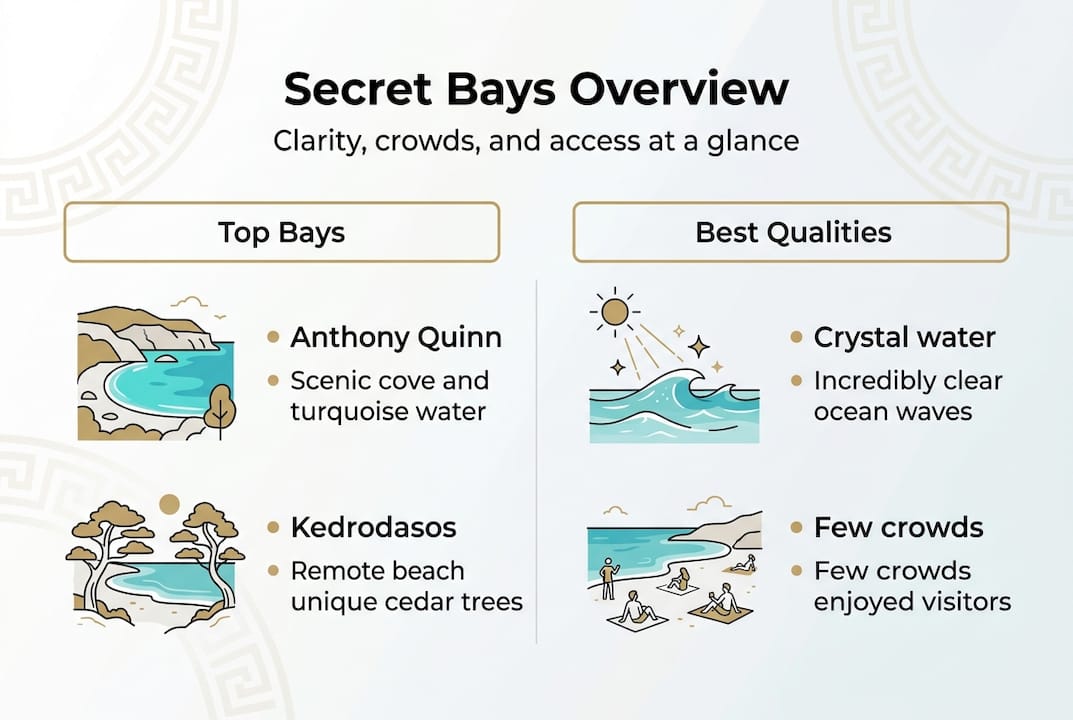
The hidden gems across the Greek islands follow a clear pattern: the harder the access, the clearer the water, and the fewer the people.
Hidden gems for swimming: The best secret bays in Crete and Rhodes
With context established, let’s get specific about the places that genuinely reward the effort it takes to reach them.
Kopria Beach in Rhodes is almost unknown outside of local circles. The beach at Kopria is a hidden, local spot with pure clarity and almost no people, making it ideal for early morning swims when the water is glassy and the light is low and golden. It sits between Kiotari and Lachania on the southeastern coast, a stretch of road that most rental cars never travel. Small pebbly coves punctuate this coastline every few kilometers, each one offering privacy that the more famous beaches simply cannot match.
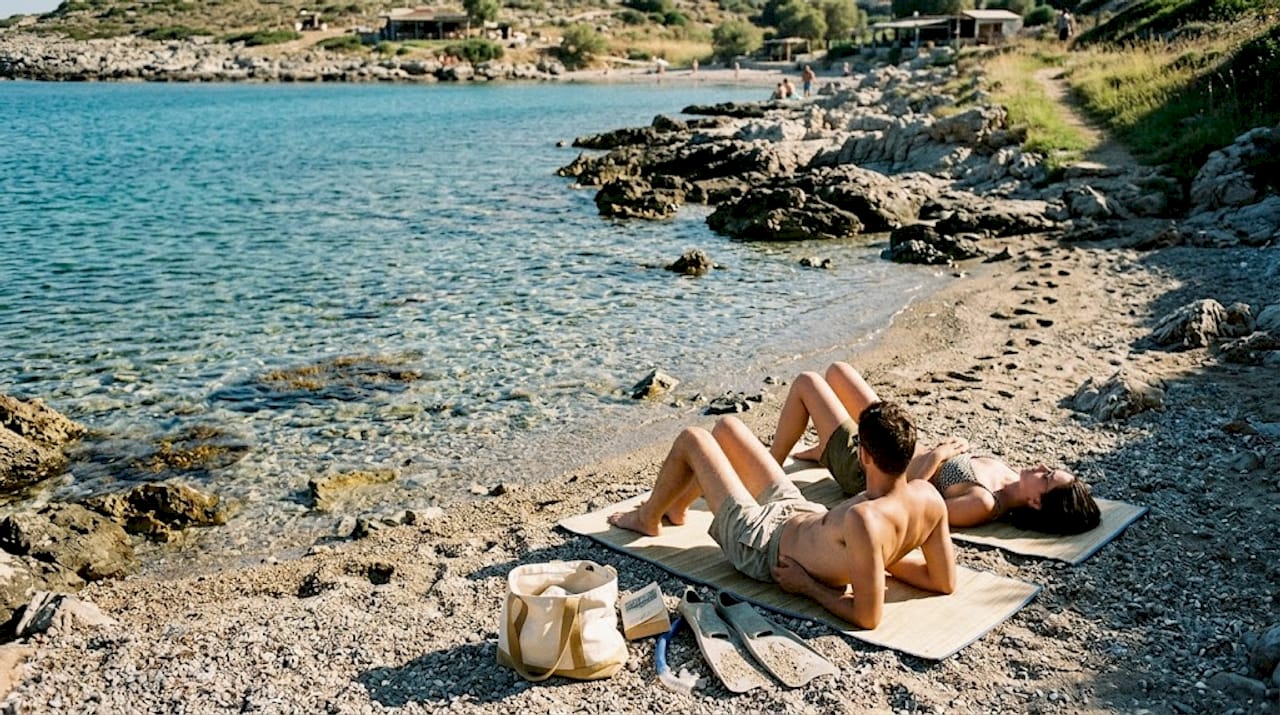
Kedrodasos Beach near Elafonissi in southwest Crete is a genuinely striking discovery. The beach at Kedrodasos is a hidden gem with white sand and turquoise waters, receiving thousands fewer reviews than neighboring Elafonissi despite being equally beautiful. A 20-minute walk through a cedar grove separates the two beaches, and that short distance filters out the vast majority of visitors. The snorkeling here is superb, with visibility stretching well beyond what most Mediterranean destinations offer.
Seitan Limania requires more nerve. The descent to this narrow inlet is steep, and the beach itself is little more than a sliver of pebble. But the tips for visiting Seitan Limania confirm what those who’ve made the trip already know: the water color here is unlike anything else in Crete.
For those combining swimming with light adventure, here’s a practical numbered approach to reaching these hidden spots:
- Research the access route before you leave your accommodation. Many bays have no signage.
- Set out before 9:00 a.m. to claim your space and enjoy the calmest water.
- Use Google Maps satellite view to identify the small parking areas or trailheads.
- Bring a printed or downloaded offline map since signal is often poor in remote areas.
- Check hiking and watersports guides for Greece to find routes that combine beach access with light coastal hiking.
Pro Tip: Pack a compact snorkeling mask even for beaches you haven’t researched. Many of these hidden coves have extraordinary underwater scenery that isn’t documented anywhere online.
What makes the water crystal clear? Insider tips and scientific reasons
Understanding why certain bays have such exceptional clarity helps you choose wisely and time your visits for the best possible experience.
The single biggest factor is beach composition. Sandy beaches are beautiful, but sand is lightweight and easily disturbed. Every wave, every swimmer, every passing boat stirs particles into suspension. Pebbly and rocky shores stay put. The rocks hold the seabed in place, which means even modest wave action doesn’t cloud the water. This is why the water clarity along Rhodes’ rocky bays is consistently higher, with snorkeling excelling in these environments and visibility remaining strong even in the early afternoon.
Wind direction matters enormously. West-facing beaches in both Rhodes and Crete are exposed to the Meltemi, the strong seasonal wind that sweeps across the Aegean from July through August. East-facing and south-facing bays sit in the wind’s shadow, protected by the island’s own topography. Calm water means undisturbed particles, which means clarity.
Water temperature and depth also play a role. Shallow, south-facing bays warm quickly in spring, creating stable thermal layers that reduce turbulence. These same bays tend to glow with an almost luminous turquoise because shallow water scatters blue light more intensely.
“Rocky and pebbly bays consistently offer the highest snorkeling visibility in Greece. For west-facing spots, always check the wind forecast before you go.” — Experienced Rhodes diving guide
Here are the key factors to look for when choosing a clear-water bay:
- Pebbly or rocky seabed: Reduces sediment disturbance significantly
- Sheltered position: East or south-facing bays avoid the Meltemi wind
- Low boat traffic: Motorboat wakes churn sediment and disturb clarity
- Shallow approach: Allows the full visual effect of turquoise light scattering
- Limited foot traffic: Fewer swimmers means less stirred-up sediment
Pro Tip: Check wind forecasts on Windy.com the evening before your visit. A calm forecast for your chosen bay almost guarantees exceptional visibility in the morning.
The adventure islands of Greece such as Samos, Karpathos, and Kefalonia benefit from all these factors in abundance. Kefalonia in particular, with its famous Myrtos Beach and countless unnamed coves, delivers water clarity that rivals the Caribbean. Samos offers secret bays in the shadow of Turkish mountains, creating a surreal and intimate swimming experience.
Practical advice for visiting secret bays: Getting there, gear, and etiquette
Knowing where the hidden bays are is only half the picture. Getting there safely, comfortably, and responsibly is what separates a great experience from a frustrating one.
Many of Greece’s most pristine spots require real effort to reach. The access to remote beaches like Kedrodasos involves hiking 20 to 30 minutes over uneven terrain with no facilities at the destination. Some bays are only accessible by 4x4 vehicle on unpaved tracks, or by small boat hired locally. Planning your access route the day before is not optional; it is essential.
Timing is everything. May through June and September through October offer the best combination of clear water, warm temperatures, and minimal crowds. July and August bring stronger Meltemi winds and peak visitor numbers, which affects both comfort and water clarity.
Here’s a step-by-step checklist for preparing your hidden bay visit:
- Confirm access method: walking trail, 4x4 track, or boat hire
- Download offline maps and save the coordinates before you leave Wi-Fi
- Pack at least 2 liters of water per person since there are no vendors at remote spots
- Bring snacks, sunscreen, a hat, and a dry bag for electronics
- Wear sturdy shoes for walking, even if you plan to swim immediately upon arrival
- Carry a small bag for any trash you generate
Etiquette at these bays matters more than people realize. Remote spots stay pristine precisely because they attract visitors who care. Leave nothing behind. Respect any naturist tolerance that exists at more secluded locations, and do not disturb nesting sites or protected vegetation. These are family-friendly beaches and luxury resort areas in terms of the broader islands, but the hidden coves themselves are fragile environments.
For couples, these quiet bays offer something extraordinary. A private cove at sunrise, completely to yourselves, is the kind of experience that stays with you. Many romantic Greek island getaways are built around exactly these kinds of unhurried, off-the-beaten-track mornings.
Why true island explorers skip tourist beaches: Lessons from Greece’s hidden bays
Here is what we’ve learned after years of guiding travelers through Greece’s coastlines: the most popular beach is almost never the best one.
Mainstream spots rarely deliver on the promise of that postcard image. They are crowded by 10:00 a.m., the water is churned from constant foot traffic, and the experience feels more like a shared public event than a personal discovery. The travelers who find genuine magic are the ones willing to walk an extra twenty minutes, hire a small boat, or simply drive past the obvious parking lot.
There is something meaningful about exploring hidden gems that effort alone unlocks. The crystal-clear cove you discover after a steep descent feels entirely different from the beach you simply pull up to. That difference isn’t just physical. It changes how you remember the trip. It becomes a story rather than a snapshot.
Greece rewards curiosity above almost everything else. The more you’re willing to look past the obvious, the more generously the islands give back.
Explore more secret Greek bays with curated travel programs
Finding these hidden spots on your own is entirely possible, and we hope this guide gives you the confidence to try. But for those who want to go deeper, with local knowledge, carefully timed itineraries, and access to bays that simply don’t appear in any online guide, a curated journey makes all the difference.
At Longevity Travel, our curated programs are designed around authentic Greek island experiences, combining real discovery with comfort and ease. Whether you’re drawn to snorkeling in secluded coves, coastal hiking, or even pairing your island adventure with a round of golf on Mediterranean fairways through our golf travel experiences, we build journeys shaped by decades of on-the-ground knowledge. The secret bays are waiting. We know exactly how to get you there.
Frequently asked questions
Which Greek island has the clearest water for swimming?
Rhodes’ east coast and Crete’s south-facing bays consistently offer the clearest waters, with the east coast of Rhodes featuring emerald-green, crystal-clear conditions ideal for snorkeling, and Kedrodasos Beach in Crete delivering turquoise-clear visibility with far fewer crowds than nearby Elafonissi.
How can I find the least crowded, secret bays in Greece?
Seek out pebbly coves or remote beaches like Kopria Beach in Rhodes or Kedrodasos in Crete, and Kopria Beach is almost always uncrowded with pure clarity. Visiting in May through June or September through October avoids peak crowds, and Kedrodasos receives roughly 1,600 reviews compared to Elafonissi’s 25,000, which tells you everything.
What gear should I bring when visiting Greece’s secret bays?
Pack water, snacks, sun protection, a snorkeling mask, and sturdy shoes, because access to remote spots often involves hiking or rough terrain with no facilities at the beach itself.
Is naturism allowed at secluded Greek bays?
Naturism is generally tolerated at remote and less crowded bays, but always check local rules for each specific beach and respect any posted signage or local customs you observe.
Recommended
Planning a family holiday in Greece? We'll help you pick the right island and hotel.
Explore Greek destinationsNewsletter
A memory for life
Weekly to your inbox: inspiration, longevity insights and exclusive travel offers.