
A Romantic Escape to Lanzarote
An island of black lava, white villages and the Atlantic — Timanfaya, La Geria, Papagayo and Famara. A guide to slow, romantic travel on Lanzarote.
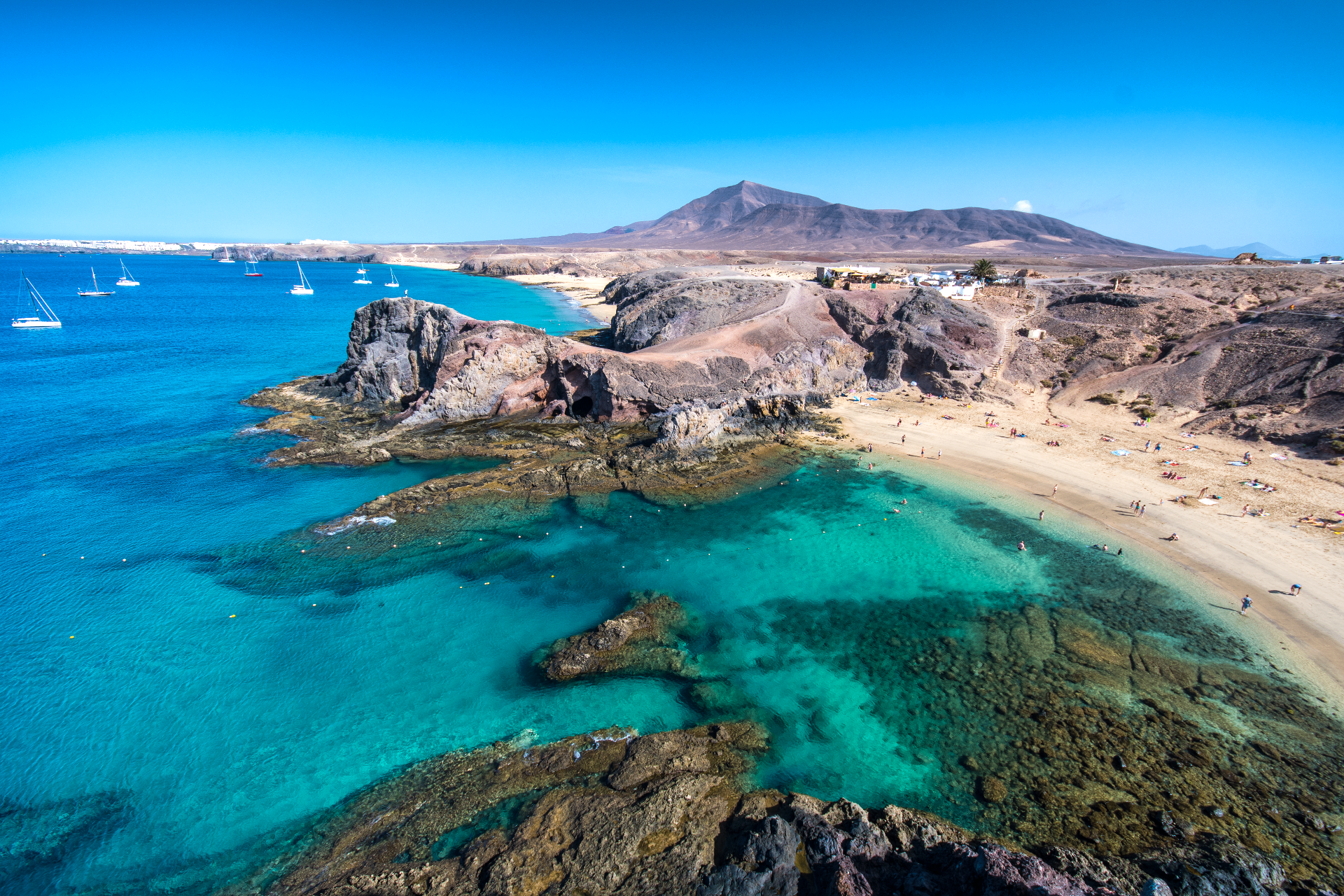
An island of black lava, white villages and the Atlantic, where beauty reveals itself in light, silence and surprising contrasts.
An island that speaks in contrasts
On Lanzarote, romance does not take the expected form of palms and tropical greenery. The island is remembered for its black lava, white villages, open sky and light that late in the afternoon softens the copper, brown and violet shades of the volcanic slopes. The landscape is dry, windy and sparse with vegetation, yet every palm, vine or patch of shade feels deliberate.
Lanzarote covers 845.9 square kilometres, roughly 55 kilometres from north to south. Distances are short, but the island is not made for rushing from sight to sight. The point of exploring it lies in slow transitions: from the black interior to the blue Atlantic, from a small village to a lonely viewpoint, from the sound of the wind to the silence of a lava tube.
UNESCO declared Lanzarote a biosphere reserve in 1993, and since 2015 the island together with the Chinijo archipelago has also been a UNESCO Global Geopark. These two titles say something essential: here nature, settlements, farmland and art are not separate worlds. The island is interesting precisely because of the way people learned to live with lava, drought and wind.
A landscape born from fire
The strongest mark was left by eruptions between 1730 and 1736. Six years of volcanic activity reshaped much of the southwest, buried villages and fertile soil, and created vast fields of solidified lava. A smaller final eruption followed in 1824. Today Timanfaya National Park protects a landscape of craters, cones and almost unchanged lava flows.
Timanfaya is not classically picturesque. Its appeal is quieter and stranger. The absence of trees sharpens shapes, colours and distances; the black terrain sometimes shifts into reddish and ochre tones, then fades toward the horizon. Visitors travel the central Route of the Volcanoes by official bus, since walking on the fragile surface is allowed only on designated paths. This is one of those places where it is pleasant to put the phone away for a while and simply look.
Art that does not compete with the landscape
The image of modern Lanzarote was strongly shaped by local artist César Manrique, a painter, sculptor and architect who returned to the island in 1966. He advocated architecture that adapts to the terrain rather than overpowering it. His works are often not placed in front of the landscape but hidden within it.
Jameos del Agua are arranged inside a lava tube of the La Corona volcano. The path descends to an underground lake inhabited by a tiny blind white crab found only on Lanzarote, then opens into a garden, pool and natural auditorium. Stone, water, plants and light are connected without unnecessary effects. On the northern edge of the island, Mirador del Río is almost carved into the cliff. Through large windows the view opens across the strait to La Graciosa, a small inhabited island without asphalted roads.
Vineyards dug from ash
La Geria shows another side of the volcanic story. When ash covered fertile soil, farmers dug deep funnel-shaped hollows and planted a vine in each one. Volcanic gravel retains moisture at night, and low semicircular walls of black stone protect the plants from the trade winds. From a distance the landscape looks like a large graphic composition: green shoots, dark circles and soft lines of volcanic cones.
The road between villages and small wineries is enough for a relaxed afternoon. The area is particularly linked to volcanic malvasia. More than the number of cellars visited, what stays in memory is the way people created a vineyard from seemingly barren earth.
Two coasts, two different rhythms
In the south are the Papagayo coves, part of the protected Los Ajaches area. Light sand and calmer, translucent water stand in strong contrast to the dark volcanic interior. On a clear day the view reaches the island of Lobos and Fuerteventura. The best-known cove can be busy, so for more peace it is worth arriving early or choosing one of the neighbouring coves.
Famara on the northwest has a completely different character. A six-kilometre sandy beach beneath the Risco de Famara cliff is open to wind and waves. People do not come here mainly for swimming, but for walking. When low tide coincides with sunset, wet sand mirrors the sky and the cliff takes on a warm edge.
On the west coast the Atlantic meets the lava even more directly. At Los Hervideros waves crash into cracks in the black shore; at El Golfo a green lagoon, Charco de los Clicos, has formed inside an open volcanic crater. A little further south lie the geometric salt pans of Janubio.
Known resorts of Lanzarote
Playa Blanca at the far south is a former fishing village that has grown into a well-kept seaside resort. A long promenade runs along the coast, nearby are quieter town beaches and a marina, and from here the Papagayo coves are easiest to reach. Across the strait, Fuerteventura and the islet of Lobos are always visible.
Puerto del Carmen is the largest and liveliest resort on the island. The old harbour still recalls fishing beginnings, while the modern part follows the long Avenida de las Playas with restaurants and the beaches of Playa Grande and Los Pocillos. It suits guests who want plenty of choice and more evening atmosphere.
Costa Teguise on the east coast is one of the main tourist centres and a good base for the north of the island. Along the promenade are Playa Bastián, Las Cucharas and the sheltered Jablillo cove; the area is also known for water sports because of the wind. Smaller Puerto Calero has a different rhythm: a tidy marina, walks among yachts and quieter restaurants by the water.
When the day settles
In October the sea averages around 23 degrees Celsius and the air remains pleasantly warm. The day can end in Haría among palm trees, over a glass of malvasia in La Geria, or on a long walk at Famara. The strongest impression often comes from a pause: the view towards La Graciosa, the silence of the underground lake or the last light on volcanic stone. Lanzarote does not work through excess. Its difference lies in space, simplicity and the feeling that nature is always slightly larger than people.
Find your holiday in the Canary Islands: longevitytravel.life/en/travel/kanari
Does the Canary Islands sound like your next escape? Send us an inquiry and we'll craft a program tailored to you.
Send inquiryNewsletter
Spomin na življenje
Tedensko po e-pošti: navdih, izbrani nasveti za dolgoživost in ekskluzivne ponudbe potovanj.