
When Is the Best Time to Visit Greece in 2026
Discover when is the best time to visit Greece in 2026. Explore optimal months for warm weather, fewer crowds, and great prices!

TL;DR:
- May and September are the optimal shoulder months to visit Greece, offering favorable weather, fewer crowds, and better value. September features the warmest seas and a more relaxed travel experience with fewer disruptions from the Meltemi wind. Both months provide ideal conditions for exploring, swimming, and cultural immersion, tailored to different travel preferences.
Most travelers assume July or August is the obvious answer when asking when is the best time to visit Greece. The reality is more nuanced, and often more rewarding. The shoulder months of May and September consistently outperform peak summer on nearly every measure that matters: comfortable temperatures, calmer seas, lighter crowds, and better value. This guide breaks down Greece’s travel seasons with specific data for 2026, so you can choose the timing that fits your travel goals rather than following the crowd.
Table of Contents
- Key takeaways
- Greece travel seasons and regional climate zones
- Why May is one of the best months to visit Greece
- Why September may be the ideal month for island hopping
- May vs. September: choosing the right month for you
- Other seasons worth considering
- My perspective on timing your Greece trip
- Plan your ideal Greece trip with Longevitytravel
- FAQ
Key takeaways
| Point | Details |
|---|---|
| May and September are optimal | Shoulder months offer the best balance of warm weather, lower prices, and fewer tourists. |
| September has the warmest seas | Sea temperatures reach 24–26°C in the Cyclades, ideal for swimming with 30–50% fewer visitors than August. |
| May needs early ferry planning | Ferry services ramp up by mid-May, so book 4–6 weeks ahead to secure island-hopping routes. |
| Peak summer is intense | July and August bring 38°C+ heat, maximum crowds, and Meltemi wind disruptions to ferries. |
| Winter suits city travelers | November through March offers 40–60% price reductions but very limited island operations. |
Greece travel seasons and regional climate zones
Greece is not one climate. It is three distinct zones, and knowing which one you are visiting changes everything about your planning.
- Aegean zone (Cyclades, Dodecanese, eastern islands): Hot, dry summers with the famous Meltemi wind blowing from the north between July and early September. This wind cools the air but can make ferry crossings rough and delay departures.
- Ionian zone (Corfu, Kefalonia, Zakynthos): Milder, more humid, and slightly greener than the Aegean. Less affected by the Meltemi, making it more consistent for summer travel.
- Mainland and northern Greece (Athens, Thessaloniki, Peloponnese): Hotter and drier inland, cooler and wetter in the north. Athens summers are intense, often uncomfortable for prolonged sightseeing in July and August.
Understanding these zones helps you match your destination to your preferred travel window. The Ionian islands, for example, hold their beauty and accessibility longer into October than the Aegean islands, which begin winding down services in late September.
Greece’s tourist season follows a predictable arc. High season runs from July through August, bringing maximum heat, maximum crowds, and the full range of services. Shoulder season covers May through June and September through October, offering gentler conditions and a more personal experience. Low season spans November through March, when many islands go quiet and the focus shifts to mainland cities and cultural sites.
Why May is one of the best months to visit Greece
May sits in a rare sweet spot. The rains of spring have cleared, the tourist crowds have not yet arrived, and the light across the islands is extraordinary.
Average temperatures in May range from 20 to 26°C, with 10 to 12 hours of sunshine daily and very low rainfall. Sea temperatures run between 18 and 21°C, which is refreshing rather than warm. Most swimmers find this cool for extended beach days, but perfectly suited for a morning dip before a long lunch in the shade.
The practical advantages are significant:
- Crowds: A fraction of what you will encounter in July or August. Major sites like the Acropolis, Santorini’s caldera path, and Mykonos Town are walkable and enjoyable rather than exhausting.
- Prices: Hotel rates in May run 25 to 40% lower than peak summer, with more availability at preferred properties.
- Atmosphere: Locals are still present in village life. You experience the real rhythm of Greece rather than a version of it staged for tourists.
- Scenery: The hills and countryside are still green from spring rains, offering a different visual quality than the sun-bleached landscapes of July.
For island hopping, May is viable from mid-month onward, when ferry schedules reach closer to full summer frequency. Early May ferry travel can be unpredictable due to the ramp-up of services.
Pro Tip: Book ferry tickets 4 to 6 weeks in advance for May travel. Walk-up tickets are not reliably available during shoulder season weekends, and popular routes between Piraeus, Santorini, and Mykonos fill quickly.
Top destinations in May: Crete for its wildflower landscapes and uncrowded beaches, the Peloponnese for ancient ruins without the heat, and Paros for a genuinely relaxed island experience before the crowds arrive.
Why September may be the ideal month for island hopping
If May is about freshness and possibility, September is about warmth and ease. Many experienced Greece travelers consider it the single best month of the year, and the data supports that view.

Sea temperatures in the Cyclades reach 24 to 26°C in September, the warmest of the entire year. The long Greek summer has heated the water gradually, and you feel it. Swimming in September is genuinely luxurious in a way that May simply cannot match.
The operational picture improves considerably as well:
- Crowds: 30 to 50% fewer visitors than August, with a sharp drop after the first week of the month as European school terms resume.
- Prices: Accommodation and flights soften noticeably. You often find the same quality of stay at a meaningfully lower rate.
- Meltemi winds: These strong northerly winds that disrupt ferry operations from July through early September weaken dramatically by mid-month. Calmer seas mean more reliable crossings and more comfortable beach days.
- Services: Most restaurants, bars, and water sports operators are still fully open, unlike late October when seasonal businesses begin closing.
Pro Tip: Aim for mid-September as your sweet spot. The crowds from August have cleared, the Meltemi has quieted, and several islands celebrate the wine harvest. On Santorini in particular, the grape harvest in mid to late September offers a cultural experience you simply cannot replicate in peak summer.
September also suits food enthusiasts. The combination of warm evenings, fresh seasonal produce, and Greek island cuisine at the height of the season creates meals you remember for years.
May vs. September: choosing the right month for you
Both months are genuinely excellent. The right choice depends on what you value most.
| Factor | May | September |
|---|---|---|
| Air temperature | 20–26°C, comfortable for sightseeing | 25–30°C, warm and settled |
| Sea temperature | 18–21°C, cool to refreshing | 24–26°C, warm and inviting |
| Crowd level | Very low | Low to moderate (drops sharply after week one) |
| Prices | 25–40% below peak | 20–35% below peak |
| Daylight hours | 14+ hours, long days for exploration | 12–13 hours, still generous |
| Ferry reliability | Good from mid-May, book early | Excellent, especially from mid-month |
| Cultural highlights | Easter celebrations, spring scenery | Wine harvest, summer festivals winding down |
| Best for | Sightseers, hikers, cooler-climate preference | Swimmers, island hoppers, food and wine travelers |
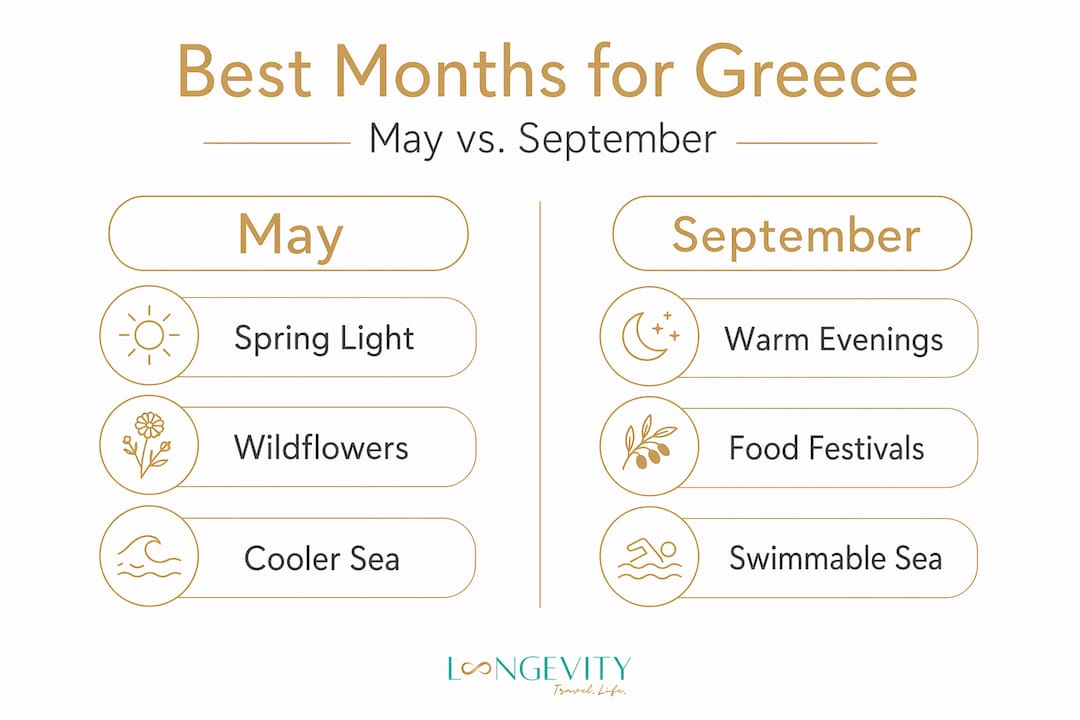
If swimming and beach time are central to your trip, September is the clearer choice. The sea is significantly warmer, and you will not feel that hesitation before entering the water.
If you prefer longer days for exploring ruins, hiking coastal paths, or photographing landscapes in softer spring light, May rewards you in ways September cannot. The green hills and hidden bays of late spring carry a visual quality that the sun-bleached August landscape has lost by September.
Families with school-age children often default to July or August out of necessity. If flexibility exists, even the first week of September before most European schools return offers a dramatically more comfortable experience than the August peak.
Other seasons worth considering
Greece in July and August is not without its appeal. Festivals are abundant, every service is operational, and the energy across the islands is electric. The summer festivals and outdoor performances, particularly at the Epidaurus theater, are genuinely special. But peak summer heat regularly exceeds 38°C in Athens, and the Meltemi can delay or cancel ferries without warning. Go in peak season with realistic expectations, not wishful ones.
A few other windows worth knowing:
- June: Warmer air and sea than May, more crowds than May, but still manageable compared to July. A good compromise if May dates do not work.
- October: Early October shares many of September’s advantages, though island services begin scaling back from mid-month onward. Crete and Rhodes maintain good conditions well into October.
- November to March: Winter offers 40 to 60% hotel rate reductions and deeply authentic city experiences in Athens and Thessaloniki. Island life is largely paused. Right for budget-focused travelers who want cultural depth without beach expectations.
- Hiking and activity travel: Spring and early autumn are the best windows for hiking and watersports. Summer heat makes strenuous activity uncomfortable, and trail conditions in May are exceptional.
My perspective on timing your Greece trip
I have been shaping Greece travel experiences for over three decades, and I still encounter the same pattern. A traveler comes back from August in Santorini and describes standing in a two-hour queue for a sunset view, a ferry cancellation in 40°C heat, and a hotel room that cost more than anything they have ever paid before. Then I ask them: what made you choose August?
The answer is almost always “because that is when everyone goes.”
That reasoning deserves examination. Greece in shoulder season does not ask you to sacrifice anything meaningful. You get warmth, clear skies, open restaurants, and ferry routes that work. What you lose is the crowd itself. And for most travelers I have worked with, losing that crowd is the entire point.
September, in my experience, consistently produces the most satisfied travelers. The sea is at its best. The pace of island life is unhurried but still alive. And the cultural texture of the place, those quieter village mornings and evening meals that stretch well past midnight, comes through in a way that peak season simply does not allow.
My honest advice: choose May if you love light, landscapes, and space. Choose September if you want to swim well, eat well, and feel Greece rather than just see it. Both will serve you far better than July or August for most goals. And if you are still undecided, consider a Greece public holidays calendar before you finalize dates. Local holidays affect crowds and services in ways that month-level planning alone will miss.
Greece rewards those who travel with intention. Timing is part of that intention.
— Robert
Plan your ideal Greece trip with Longevitytravel
At Longevitytravel, we have spent more than thirty years learning when Greece is at its most restorative, and building programs around those windows. Our curated Greece programs are designed specifically for May and September travel, when the conditions align with genuinely life-enhancing experiences. Whether you are drawn to a wellness retreat on a quieter island, an unhurried cultural journey through the Peloponnese, or a food and wine experience timed to the September harvest, we handle the details that make the difference. Ferry bookings, seasonal property selections, daily rhythms calibrated to the time of year. If you are ready to move from wondering when to go to actually planning it, we are here.
FAQ
What are the best months to visit Greece overall?
May and September are consistently the best months, offering warm weather, manageable crowds, and lower prices compared to the July and August peak season.
Is the sea warm enough to swim in May in Greece?
Sea temperatures in May average 18 to 21°C, which is refreshing but cool for extended swimming. September offers significantly warmer water at 24 to 26°C, making it the better choice for beach-focused trips.
How far in advance should I book ferries for May travel in Greece?
Book ferry tickets 4 to 6 weeks in advance for May travel. Ferry services ramp up gradually through mid-May, and walk-up tickets on popular routes are not reliably available.
What is the Meltemi wind and when does it affect travel?
The Meltemi is a strong northerly wind that blows across the Aegean from July through early September. It can rough up seas, delay ferries, and make beach days uncomfortable. It weakens significantly after mid-September.
Is Greece worth visiting in winter?
Winter travel suits budget-focused travelers interested in Athens or Thessaloniki for history and culture. Hotel rates drop 40 to 60%, but most island businesses close and beach travel is not viable between November and March.
Recommended
Planning a family holiday in Greece? We'll help you pick the right island and hotel.
Explore Greek destinationsNewsletter
A memory for life
Weekly to your inbox: inspiration, longevity insights and exclusive travel offers.